What counts as a callback?
A callback is a free return visit to fix a problem with a service the customer already paid for. Two other kinds of visits can look the same on the schedule:
- A follow-up that's part of the service. Some treatments need a second visit. One Indiana company now books a follow-up with every flea service, because most of its flea calls came from the pest's life cycle, not a missed treatment (PCT Online, August 2023).
- A new problem. A different pest, or a new season's pressure, can be a new sale rather than a callback.
A written rule usually needs a time window too, such as "a free return visit within 30 days of the service." Without one, an old job can turn into a callback months later.
How often should callbacks happen? PestPac's industry standards page (updated September 2026) calls a callback rate under 3% good and over 6% a cause for alarm. That range tells you how many callbacks your pay rule has to handle.
What are the three ways to pay a callback?
Here's one callback paid each way. The first visit was a $150 quarterly service that paid the tech $27 (18%). The callback took 45 minutes.
One callback, paid three ways
Sample rates to show the math. Not any real company's pay plan.
| Rule | Who goes back | Callback pay | Original tech keeps | Extra labor cost to the company |
|---|---|---|---|---|
| No commission on callbacks | The original tech | $0.00 | $27.00 | $0.00 |
| Hourly for time on site ($20 an hour) | Whoever is closest | $15.00 | $27.00 | $15.00 |
| Charge-back to the original tech | Another tech, paid $20 an hour | $15.00 | $12.00 | $0.00 |
Each rule rewards something different:
- No commission. Rewards getting it right the first time. A landscape company that borrowed its production pay plan from a pest control firm doesn't pay for rework visits, for exactly that reason (NALP, The Edge). The catch: it feels unfair when the callback wasn't the tech's fault, and the time still counts as hours worked (more on that below).
- Hourly. Gets the customer helped fast, because nobody loses money by going. The catch: it can quietly pay for sloppy work, so it works best when someone watches callbacks by tech.
- Charge-back. Puts the cost on the tech who caused it and pays the tech who fixes it. The catch: every charge-back starts a conversation about fault, so it only works with a clear reason on file. A charge-back also lowers someone's pay. Under federal wage law, no deduction can bring a week's pay below the minimum wage or cut the overtime owed (U.S. Department of Labor). Some states also treat a commission as wages once it's earned and limit taking it back afterward. New York's labor department says so, for example. So the key question for a labor attorney is when a commission counts as earned under your plan. Have the charge-back wording reviewed before using one.
Our view: charge-backs carry the most risk. We include them because some owners use them, and if you do, the cautions above apply. But a charge-back takes money from a tech after the fact, and that's where the legal risk and the arguments live. It can also teach techs to dodge callbacks, which hurts the customer most. The no-commission rule holds the original tech accountable without taking back pay they've already earned.
Some companies skip the penalty side entirely and reward the opposite: a bonus for few avoidable callbacks. ShareWillow describes a pest control company that worried production pay alone would teach techs to rush, so it added quality measures to the plan. A bonus like that needs the same "whose callback is it?" record to work.
Beyond pointing out the risk in charge-backs, we don't tell owners which rule to pick. That's a business decision. What matters is that the choice is written down and applied the same way every pay period.
Whose callback is it?
The rule matters less than the decision behind it: whose callback is it? A no-commission rule, or a charge-back if you use one, only feels fair when the office writes down the reason before anyone gets paid.
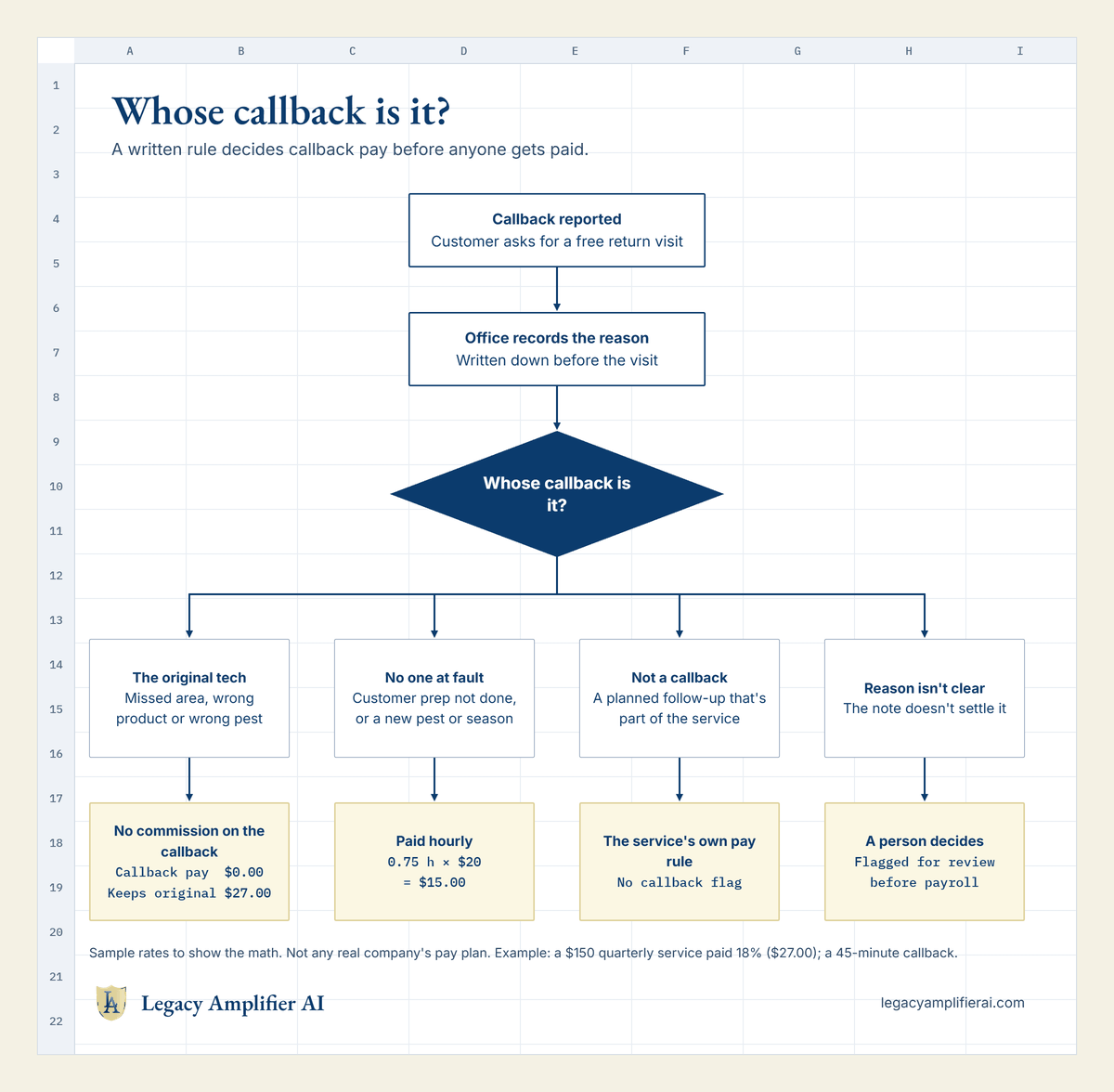
Callback reasons and how a written rule might treat them
Sample rules to show the idea. Not any real company's pay plan.
| Reason in the office note | Whose callback | How a rule might treat it |
|---|---|---|
| An area was missed, or the wrong product was used | The original tech | No commission on the callback (charge-back only after legal review) |
| The pest was misidentified | The original tech | No commission on the callback (charge-back only after legal review) |
| The customer didn't do the prep | No one | Hourly |
| A different pest, or a new season | No one; it may be a new sale | Hourly, or quote a new service |
| A planned follow-up that's part of the service | Not a callback | The service's normal pay rule |
| The reason isn't clear | A person decides | Flag for review |
These reasons come up often. MGK, a pest control product maker, lists misidentifying the pest as one of the most common causes of unnecessary callbacks. And a Kingwood, Texas, owner told PCT Online that with ants, the customer has to be part of the plan, or they can undo a treatment without knowing it.
What does each rule cost over a month?
Take 100 services. At PestPac's 3% callback rate, that's 3 callbacks. At 6%, it's 6. Each one takes 45 minutes.
Callback cost per 100 services
Sample rates to show the math. Not any real company's pay plan.
| Rule | At 3% (3 callbacks) | At 6% (6 callbacks) |
|---|---|---|
| No commission | $0 extra pay. Techs spend 2.25 hours on callbacks with no commission. | $0 extra pay. Techs spend 4.5 hours. |
| Hourly ($20 an hour) | $45.00 extra pay | $90.00 extra pay |
| Charge-back | $0 net. $45.00 moves from the original techs to the techs who went back. | $0 net. $90.00 moves. |
At a healthy callback rate, the dollars are small under any rule. What changes is behavior: who goes back first, how fast the customer gets helped, and whether techs trust the reason on file.
Does a $0 callback still count as time worked?
Yes. Under federal wage law, techs who are paid commission and aren't exempt must still earn at least the minimum wage for every hour worked. The U.S. Department of Labor checks that by dividing a week's total pay, commissions included, by the total hours worked that week. Callback time counts in those hours.
For example, $800 earned in a 40-hour week works out to $20.00 an hour, well above the $7.25 federal minimum. Weeks over 40 hours bring overtime into it, and overtime on commission pay has its own rules.
This isn't legal advice. A labor attorney can check your callback rule against federal and Texas law.
How should a job worked by two techs be split?
Here's a $1,200 rodent exclusion that pays 10%, so there's $120 of commission to divide. Tech A was on site 5 hours. Tech B was there 3 hours.
One $1,200 job, split four ways
Sample rates to show the math. Not any real company's pay plan.
| Split rule | Tech A (5 hours) | Tech B (3 hours) | Total paid |
|---|---|---|---|
| 50/50 | $60.00 | $60.00 | $120.00 |
| By time on site | $75.00 | $45.00 | $120.00 |
| Lead and helper, 70/30 | $84.00 | $36.00 | $120.00 |
| No rule: both techs paid in full | $120.00 | $120.00 | $240.00 |
- 50/50 is the simplest. It's fair when both techs do similar work, and it feels unfair when one shows up late or leaves early.
- By time on site follows the effort. It depends on check-in and check-out times being right, and it can pay a fast, experienced tech less than a slower one for the same work.
- Lead and helper rewards the tech who runs or sold the job. The shares need to be set ahead of time so nobody argues them job by job. ServiceTitan's help pages use 50/50 and 75/25 as examples.
- Selling is separate. If one tech sold the job and another did it, the sale and the work are usually paid under different rules. ServiceTitan's help pages, for example, keep the seller's commission apart from the split between the techs who did the work. Neither tech should get the whole work pool for selling.
- Covering a route isn't a split. When one tech runs another's route for the day, each job belongs to the tech who did it, not the tech it was scheduled for.
- No rule is the costly one. ShareWillow describes a multi-trade company that nearly paid commission twice on the same install before anyone caught it.
Software has defaults, and defaults make decisions nobody wrote down. ServiceTitan's help pages say 100% of a job's split goes to the first technician assigned unless someone changes it. In FieldRoutes, the technician assigned to an appointment and the technician who serviced it are separate fields, according to FieldRoutes' API documentation (checked November 2026). Either way, a split rule has to say whose name gets the credit.
What about a callback on a shared job?
Use the same "whose callback is it?" test. If the reason points to one tech, the callback is theirs. If the cause was shared, a simple approach is to split the charge the same way the original job was split.
The reverse matters too. When a second tech goes back to fix a job one tech did alone, the original job doesn't turn into a shared job. The second tech is paid under the callback rule, and the original split stays as it was. That keeps dispatch decisions (who's closest) apart from pay decisions (who did the work).
What does a written callback and split rule look like?
Sample written rules
Sample rules to show the idea. Not any real company's pay plan.
Callbacks. A callback is a free return visit within 30 days of a completed service, for the same pest at the same address. The office records the reason before the visit. If the reason is a missed area, the wrong product or the wrong pest, the original tech goes back and the callback pays no commission. The original commission stays as paid, and the callback time is still counted as hours worked. Any other reason is paid hourly to the tech who goes. A person decides any reason that isn't on this list.
Shared jobs. When two techs work one job, the commission is split by time on site, using check-in and check-out times. If either time is missing, the office manager sets the split and writes down why.
Our guide on how to calculate pest control commissions from FieldRoutes shows where these rules fit in the full payday process.
Once rules like these are written down, applying them every payday stops depending on one person's memory. One pest control office manager got 6 to 8 hours a week back on commission math. That's close to a full workday, every week. We work with pest control owners from Pearland, near Houston.
Want the whole payday method? Read how to calculate pest control commissions from FieldRoutes, or book a 15-minute call.
Book a 15-minute callSources
(checked 2026-11-19 unless noted)
- PestPac, "Pest Control Industry Standards," last updated September 28, 2026. Callback benchmark: under 3% good, over 6% cause for alarm. https://www.pestpac.com/blog/pest-control-industry-standards
- PCT Online, "Curbing Callbacks," August 2023. Indiana company booking a follow-up with every flea service. https://pctonline.com/article/curbing-callbacks-aug-2023
- PCT Online, "Curbing Callbacks." Kingwood, Texas, owner on customer involvement with ants. https://pctonline.com/article/curbing-callbacks
- MGK, "Managing Call Backs." Misidentification as a common cause of unnecessary callbacks. https://mgk.com/managing-call-backs-blog
- National Association of Landscape Professionals, The Edge, "How I Do It: Commission-Based Pay for Field Staff." No pay for rework visits; plan borrowed from a pest control company. https://blog.landscapeprofessionals.org/how-i-do-it-commission-based-pay-for-field-staff/
- U.S. Department of Labor, Wage and Hour Division, FLSA overview presentation. Regular rate = total weekly pay ÷ total hours; may not be below minimum wage; includes commissions. https://www.dol.gov/sites/dolgov/files/WHD/legacy/files/comprehensive.pdf
- U.S. Department of Labor, Wage and Hour Division, "Off the Clock." Minimum wage and overtime for covered non-exempt employees. https://www.dol.gov/whd/offtheclock/
- ServiceTitan Help, "Enter technician commission, job splits, and spiffs." 50/50 and 75/25 examples; 100% of the split goes to the first technician assigned by default. https://help.servicetitan.com/commercial/docs/enter-technician-commission-job-splits-and-spiffs-for-a-job-or-project.md
- ShareWillow, "The $76,000 Mistake Nobody Caught." Near double payment on one install. https://www.sharewillow.com/blog/plumbing-electrical-commission-plan
- New York State Department of Labor, "Payment of Commissions FAQ." Once a commission is earned, it is legally wages. https://dol.ny.gov/payment-commissions-faq (checked 2026-11-20)
- ShareWillow, "How a Pest Control Company Designed Pay That Rewards Quality, Not Just Speed." Concern that production pay alone teaches rushing. https://www.sharewillow.com/blog/pest-control-quality-incentive-plan (checked 2026-11-20)
- U.S. Department of Labor, Wage and Hour Division, Fact Sheet #16, "Deductions From Wages." No deduction may reduce earnings below the required minimum wage or overtime pay. https://www.dol.gov/agencies/whd/fact-sheets/16-flsa-wage-deductions (checked 2026-11-20)
- ServiceTitan Help, "Track Time & Process Payroll." Technician splits drive the performance bonus and don't override the Sold By sales commission. https://help.servicetitan.com/docs/track-time-process-payroll-1 (checked 2026-11-20)
- FieldRoutes API documentation. Separate fields for the employee assigned to an appointment and the technician who serviced it. https://fieldroutes.dev/documentation